Monday, May 20, 2013

Pop Up Show at Martine Chaisson Gallery

I have work in and upcoming group show at the Martine Chaisson Gallery.
It will be up June 1st-29th.
Opening reception: June 1st, 6-9pm
727 Camp Street, New Orleans, LA
Gallery Hours: Tuesday-Saturday 11-5


Friday, April 5, 2013

CINEMATROPE review by Eric Bookhardt

The Gambit

March 26, 2013 Visual Arts » Art Review

Review: Cinematrope, by Ryn Wilson 


D. Eric Bookhardt is intrigued by the new show at the UNO St. Claude Gallery


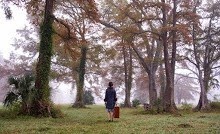
     When we were young, we may have dreamed that our grown up lives would be like movies, epic adventures in which we were the stars and wrote the script instead of our mostly uncool parents. Only as adults did we learn that life is a collaboration of luck, intention and circumstance even if our dreams remained as cinematic as ever. Walker Percy explored this theme in the novel The Moviegoer, and now Ryn Wilson offers her take on it in this Cinematrope show, in which she often stars and writes the script, yet mostly remains a creature of context. Especially emblematic is Traces (pictured), a photograph of a woman toting a vintage valise into a foggy forest in a dreamlike scene that recalls Francoise Truffaut's flair for pastoral surreality. Here the setting dominates an image that evokes a deeply psychological sense of exile. Similar subtleties are heightened in a series of elegantly oblique diptychs, but Hitchcock sets the tone in The Fallen II, where a young woman in a short schoolgirl dress sprawls lifelessly at the bottom of a winding staircase. Wilson assumes a more personal role in a video of herself running alongside Cary Grant in the airplane scene in Hitchcock's North by Northwest, and peering in windows in Preston Sturges' The Lady Eve, but most of her work effectively taps the psychic reservoirs of cinematic myth we carry around inside us.
  
    In Sophie T. Lvoff's recent photography show at Tulane University's Carroll Gallery, the city itself was the star. Shadows of ironwork on cemetery walls mimicked the secret iconography of Voodoo hexagrams as cat's claw creepers scaled the walls of a desolate hardware store and ghostly figures in outlandish costumes appeared trapped behind fogged plate glass shop windows. Lvoff's understated images effectively evoked the intimate surprises that lurk, mostly unnoticed, around every corner: the secret lives of inanimate places and objects.

— D. ERIC BOOKHARDT

through April 6
Cinematrope: photographs and mixed media by Ryn Wilson
Friday-Sunday
UNO St. Claude Gallery, 2429 St. Claude Ave., (504) 280-6493; www.unostclaudegallery.wordpress.com

Sunday, February 24, 2013

CINEMATROPE

My MFA thesis exhibition opens in two weeks!


"CINEMATROPE explores themes related to the history of film and how it affects our identity as a culture as well as our memories as individuals. Through a reevaluation of cinematic tropes, Ryn has created a series of fictional film stills. These "stills" allude to genres and repetitive imagery within the world of film without referring to any specific movie. She has created fictional movie posters with the same approach.

Her video installation explores the experience of mentally projecting oneself into a movie while watching it. Relating to characters on screen influences one’s personality as well as confuses real memories with what has been watched. Ryn physically puts herself into this position by projecting scenes from movies and inserting herself as a character into the story. She exists as both a fanatic who wants to be a part of this fictitious world, and a critic making a comment on the absurdity of the charismatic influence film has over its viewers. In this dichotomy she plays both the voyeur and the exhibitionist.
The sound is a collection of dramatic tracks taken from movies to emphasize cinema’s ability to manipulate viewers’ emotions. The soundtrack runs twice as long as the picture, illustrating the influence sound has over perception."


UNO St. Claude Gallery 
2429 St. Claude Ave. 
New Orleans, LA 70117

Exhibition dates: March 9th-April 6th

Opening reception: March 9th, 6-9pm
Closing reception: April 6th, 6-9pm

Open Fri-Sun, 12-5pm
(Closed March 29th-31st for spring break)

Thursday, October 4, 2012

Review: New works at St. Claude Avenue galleries

I currently have a few photos in a group show at Barristers Gallery. Here is an excerpt about the show from the Gambit.

Review: New works at St. Claude Avenue galleries 

D. Eric Bookhardt on the latest exhibits at Byrdie's Gallery and Barrister's Gallery

More graphical extrapolations appear at Barrister's Gallery, in Wendell Brunious' Buried Alive painterly pop collages of comic strip characters interwoven with visions of black female stardom, most pointedly in the form of Whitney Houston. Something about the way this is layered is both musical and wavelike, suggesting a visual dirge for the drowned diva. The mood turns ambiguous in Vanessa Centeno's abstract compositions, where viscous reds vie with more bilious shades in works mingling saturated sensuality with creepy science fiction overtones. If this sounds noir, it is.

  Ryn Wilson's large pseudo film stills of elegant women carrying valises deep into foggy forests, or appearing only as a pair of shapely lifeless legs under a blue velvet dress, convey a darkly atmospheric romanticism, a hint of looming oblivion accompanied, implicitly, by an elegant soundtrack. — D. ERIC BOOKHARDT


This is How We Roll: UNO graduate student work curated by Dan Tague and Tony Campbell
Barrister's Gallery, 2331 St. Claude Ave., (504) 710-4506; www.barristersgallery.com

Show ends Oct. 6th.


Wednesday, May 30, 2012

Martin-Gropius-Bau Museum, Berlin

I recently traveled to Berlin where we visited two exhibitions at the Martin-Gropius-Bau Museum. The first, and one of the best I've been to lately, was PACIFIC STANDARD TIME: Art in Los Angeles 1950–1980. This time and place was central to the first wave of feminism, and the exhibition included many seminal works in the women's movement. The show was divided into three parts. The first titled Crosscurrents, displayed work from over 50 artists including Judy Chicago. The most impressive piece in this section was Edward Kienholz's room installation of old fashioned radios, whose varying sounds were activated by pedals. It was most successful when multiple people were interacting with it from different parts of the room. The radios were attached to old fashioned tables by a clear glue which was poured over each one. One was in an aquarium, one was attached to a dismembered mannequin arm, and in the center there was a group set up with washboards and Nazi medals. Here the radios stood in for men while the washboards represented women during the war. The medals, which were given to women who could produce four or more children for the Nazi party, were hung over them.
The second part, titled Greetings from L. A. , was packed full of over 200 important objects, many of them from the feminist movement. Photographs from Eleanor Antin's 100 Boots were on display as well as a series of text typed on notecards by Martha Rosler.
 This part also included video, photo and text documentation of the Womanhouse project run by Judy Chicago and Miriam Schapiro at the California Institute of the Arts Feminist Art Program.
There was so much work packed into this section that it was really hard to take it all in. One of the last pieces in this section was a room installation by Bruce Nauman in which the viewer walked around a square room with a cube of walls in the center and surveillance cameras and video screens on the corners. As the person turned the corners, they could see a glimpse of themselves if they looked back at the video screen behind them.

The third section of the exhibit was  dedicated to Julius Shulman's photographs of modernist architecture.

The second exhibition we visited was Building the Revolution: Soviet Art and Architecture 1915–1935. It included works of the early avant-garde by El Lissitzky, Gustav Klutsis and Alexander Rodchenko among others. These works, which were revolutionary in the world of visual arts also held great influence over the Russian revolution.
  
This exhibition also discussed the innovative town planning and communal housing at the time. This was displayed through vintage photographs as well as beautiful photographs taken by Richard Pare in 1993 of the decaying buildings.


Friday, May 4, 2012

Young German Photographers and the EPEA

Two new photo shows opened recently at Hamburg's Deichtorhallen. The first was Young German Photography, an annual competition for graduate students final year projects. Seven were chosen and there was quite a range of approaches.

Miriam Schwedt exhibited a series of lithographs.
These images were so beautiful in their quality of light and subject matter, I thought the rising tides looked like mountaintops. There were a few images of construction machinery which I felt could have been left out as they didn't fit with the rest of her work.

Luise Schröder had an interesting approach and she displayed a video of her process. She laid out a pile of old photo books and subjected them to the four elements, water, fire, wind and earth.
 From the debris she created images that looked like this.
The pictures were large scale, which meant the original images were blown up to many times their original size, losing image quality. I would have preferred smaller images, or perhaps framed bits of the debris. The transition to digital reproductions could, however be a comment on how the digital world is a fifth element.

Sara-Lena Maierhofer did a series exploring the phenomenon of the imposter. She analyzed the identity of the con artist Clark Rockefeller through unexpected photographic journey. Here are some of her findings.


The other work was less interesting to me, but I was impressed to see that five of the seven photographers were women.You can see more work from this and past exhibitions here.

The second show was the European Photography Exhibition Awards. The organization appointed twelve photographers to create work concerned with “European Identities”, providing them with grants and photography workshops to aid in creating the photo essays. 

Gabriele Croppi's created surreal scenes of a past era in his stark black and white architectural photographs.
Hannah Modigh's eloquent series on adolescence showed awkward and private moments of young adult lives. It was very personal and raw, but her soft colors and the lush surface of the papers she printed on gave it a nostalgic aura.
Marie Sjøvold's subject was motherhood and she explored the altered world view which a woman with a newborn child experiences.


Thursday, April 19, 2012

Saul Leiter and Wim Wenders at the Deichtorhallen

The Deichtorhallen Hamburg had a retrospective of Saul Leiters work, including his photographs, paintings, collage and fashion photography.


I didn't find his paintings very interesting, but his paintings on photographs were really something special. His color palette was quite unexpected and sometimes you couldn't see any traces of the photograph so that if you weren't aware, it wouldn't be apparent that there is a photo underneath. His use of mirrors, windows and light distortion was constant through his art and fashion photography. Many of the techniques he used are commonplace today and thus don't sound very original, but he was one of their pioneers and he did it with such grace.

Wim Wenders had a photography show at the Deichtorhallen as well, at the Sammlung Falckenberg collection in Harburg. To my dissapointment, and for most of those who went that I spoke with, his photographic works were underwhelming. As my friend Lumen pointed out, you could stop his films at any given moment and find a much more interesting image than the ones presented in this show. I think part of the problem was the scale. The photographs were printed very large, which seemed to accentuate their banality. They were more impressive in the catalog than on the wall. In his statement, Wenders explains that he makes these images when he's getting lost while wandering and stumbling upon strange and quiet places. It surprises me that he has this strong feeling for the moments he captures, and he is such a talented filmmaker, but that feeling doesn't emanate from the photographs like they do in the films.